Wednesday, June 20, 2012

Aji Amarillo - A Spectacular Hot Pepper

.Aji Amarillo
A medium hot capsicum baccatum

Imagine a dried apricot crossed with a moderately hot pepper.
Aji Amarillo is a spectacular dried pepper. No wonder
 they're so popular with chili-heads.


The bright orange fruit were 5 to 6 in. long. They turn "amarillo"when roasted or cooked but retain the orange coloration when dried. Aji Amarillo are commonly used in Peruvian cuisine.


 These are the largest pepper plants I've grown - over 6 ft tall - in reality they're too large to plant in a container. They take about 4 months to flower and 6 to 7 months to produce ripe orange peppers.

  Seeds are widely available online.
 

Thursday, May 24, 2012

Edible Art

Yellow Furry Boar

I love the tomatoes from
They're delicious works of art.

Yellow Furry Boar make an incredible salsa
 with a sweet citrus like flavor.

Monday, January 2, 2012

A Winter Squash Super Star of 2011

 
Waltham Butternut Squash, Redventure Celery
Rio Zape Shell Beans

In 2011, I trailed five winter squash I hadn't grown before and Waltham Butternut was the only one that was sweet and flavorful. Waltham was as tasty as my 2010 favorites - Greek Sweet Red and Sweet Kikuza.

Waltham were not large squash - they averaged 2 to 3 lbs with 2 to 3 fruit per plant. I planted the seeds in July and this variety was hardy enough to tolerate the intense summer sun.

Kiawe (mesquite) grows in the fields around my neighborhood and I pick up the small dried branches and use them on my grill. I grilled sliced Waltham Butternut with kiawe chips and made this very tasty soup:
Wood Grilled Butternut Squash Puree

I also grilled sliced Waltham Butternut when grilling cedar planked salmon and the cedar added a delicious flavor too.

Sunday, September 11, 2011

Sweet & Hot Red Pepper Favorites of 2011

 In early February, I planted 20 varieties of peppers that I hadn't grown before and these were my favorite reds.

Rosso Dolce Appendere
A sweet Italian frying pepper

Bell peppers, and most of the sweet peppers, are in the Capsicum Annuum classification. They're difficult to grow in Kihei due to the climate and the relentless bugs but this summer I had great results with Rosso Dolce. They're a 4 to 5 inch long sweet frying pepper, similar to Jimmy Nardello but Jimmy doesn't grow too well in Kihei.

Nepalese Bells (aka Christmas Bells)
A sweet and slightly hot pepper

Nepalese Bells, a Capsicum Baccatum, was a late season pepper that took 6 months from seed until the first ripe fruit. The Rosso Dulces in the previous photo and the Nepalese Bells were harvested the same day but the Rosso Dolces were the 2nd crop of the summer and the Nepalese were the first. The Nepalese Bells were 2 to 3 inches wide.

A Nepalese Bell towers over the Rosso Dolce Appendere

The Nepalese were 4 to 5 foot tall plants with long branches. Surprisingly, I was able to grow them in large self-watering containers.

Shiso
A sweet and slightly hot Japanese pepper
Mahalo Mac for the Shiso seeds!

Shiso, a Capsicum Annuum, is a sweet, slightly hot and crinkled pepper. They struggled with the Kihei climate and still produced two crops of peppers this summer. The Shiso peppers were 2 to 3 inches long.
 
Aji Angelo
A moderately hot South American pepper

Aji Angelo, a Capsicum Baccatum, was my favorite of the Aji peppers that I grew this year. They were 2 to 3 inches long, fruity and not quite as hot as a jalapeno. They're a good pepper for making a not too hot salsa.

Aji Angelo was also a late variety and took over 6 months from seed to the first ripe fruit. The plants were as tall as the Nepalese Bells but looked like small trees. I was able to grow them in large self-watering containers.

Monday, July 4, 2011

Harvesting Wild Kiawe Beans


Kiawe is the Hawaiian word for mesquite - it grows wild in the arid desert areas of the islands and it grows in the open fields in Kihei.

In July, the kiawe trees are full of blossoms and beans in various stages and the trees will continue to produce pods throughout the summer.

A brief history of kiawe in Hawaii


As an island food, Kiawe beans have been forgotten but these bean pods are edible and taste like honey. In fact years ago kiawe honey was an export crop on Maui.

After the beans are harvested they need to be dried completely before they can be ground into flour. There's a local insect that sometimes bores small holes into the pods but they're still usable. Since the beans are dried, any insects or larvae would leave the pod before it's time to grind them. The beans can also be fire roasted prior to grinding


How to Harvest Mesquite is a short and informative YouTube video. In Tuscon, harvesting mesquite beans each summer is an annual event. Organic mesquite flour retails for $18/lb on Amazon.

The pods must be completely dry in order to grind them in to flour. They can be dried in the sun or in an oven on a low temperature.

Lots of photos, nutritional information and recipes can be found
on the Desert Harvesters website.

An article about a neighborhood in Tucson with kiawe trees in their sustainable landscape design:
Eat Mequite!

Information and links to uses and recipes for kiawe flour:
Native Cultures: Mesquite Flour

And, more information about kiawe in Hawaii:
Kiawe: Hawaii's Tropical Mesquite

Friday, June 10, 2011

Italian Zucchini Favorites of 2011

This spring I grew an assortment of Italian zucchini
 from different regions of Italy.


Bianco di Trieste was a symmetrical 3 ft wide bush with beautiful pale green fruit. Seeds were planted in mid-February and the first female flowers opened in 4 weeks. The fruit were best when harvested just after the flowers closed.

Bianco is an excellent variety to grow for male flowers and small zucchini. I would not recommend it for growing mature fruit as they aren't particularly attractive when full grown.


Romanesco were big vining bushes - they had the largest leaves of all the varieties I trialed. The first female flowers opened in 5 weeks. The plants produced long ribbed fruit that can be harvested small or mature. Romanesco was a good variety to grow as an all purpose zucchini as it produced good quality flowers as well as mature fruit.


Striato di Napoli (Cocozelle) and Lungo Fiorentino were lovely plants with frilly leaves. They also grew into 3 ft wide bushes and the first female flowers opened at just over 5 weeks. Striato had smooth stripes and Lungo had ribbed stripes. Both were good varieties to grow for male flowers and small zucchini that were harvested just after the flowers closed.

All of these zucchini were grown in 15 gallon SmartPots and planted from seed between mid-February through early March. The female flowers, when harvest just after they closed, remained attached to the fruit for at least 24 hours and most were large enough to stuff with cheese.

In Kihei, February was an ideal time to plant zucchini from seed. The plants survived the ever present powdery mildew better than in the warmer months. Planting in February also avoided the most destructive late spring and summer zucchini pests - pickleworms and melon fruit fly larvae.

Gourmet Seed and Seeds From Italy are good sources
 for Italian zucchini seeds.

Wednesday, June 8, 2011

Guyana - Another Fabulous Hot Pepper

Guyana

In early February, I planted 20 peppers that I hadn't grown previously. Most were from the capsicum baccatum and capsicum chinense species. One of the largest and most productive was Guyana.

Guyana grew into a good size bush that produced an abundance of 5 to 7 inch fruit. These peppers were hot, fruity and amazingly delicious when dried or fire-roasted and peeled.

Guyana is a capsicum baccatum and they're on the heat level of a typical jalapeno. Like all the peppers I've grown, they experienced a good deal of blossom and pod drop as the temps increased and sun intensified in May but it was one of the more heat tolerant of the peppers I trailed this spring.

Seeds are available from Reimer Seeds and ebay.

Thursday, April 7, 2011

Winter Shell Bean Favorites of 2011

Soissons Vert Flageolet
A French Pole Bean
Mahalo Julie for the seeds!

Flageolets are one of the most beautiful shell beans. Most are bush varieties but Soissons Vert is a pole bean with the largest bean seed I've seen in a flageolet. The plants were prolific and grew well in the Kihei winter climate.

When cooked, they lose their lovely green color but they're tender and absolutley delicious. It appears the only source in the US for purchasing seeds is the Seed Savers Yearbook. However, they are available from Ferme de Sainte Marthe  - a French seed company,

Tarbais
A French Pole Bean

Tarbais beans have been grown for generations in the Tarbes region in France. They have the reputation for being the most expensive bean on the international market and retail for over $15 per lb. Tarbais are the authentic bean for making cassoulet but they're delicious on their own.

The Tarbais were as prolific as the Soissons and grew well in our winter climate. Tarbais seeds are also available from the Seed Savers Yearbook.

Purcell Mountain Farms markets Tarbais beans for cooking - they're sold in
1 lb packages and they were my source for seeds.

Both French beans were exceptional in every way.


Borlotto Lingua di Fuoco
An Italian Pole Bean

Lingua di Fuoco are another beautiful and delicious bean. They're definitely a cool season bean and aren't as heat tolerant as the Soissons or Tarbais. If you grow these in Kihei, I suggest planting at the end of December or the 1st week of January so they're growing during the coolest months of the year.

I've grown 2 different Italian brands and I recommend Franchi. They're available in pole and bush varieties and can be purchased from Seeds From Italy. The pods develop their bright red coloration as they grow and they're easier to shell after they turn from green to ivory.

Thursday, March 31, 2011

A Dream Come True

Parisian Pickling Cucumbers
Bianco di Trieste Zucchini
Tarbais Shell Beans

This was the first harvest of a a few new to me varieties I trialed this winter. I'm so excited these seeds produced harvestable results in Kihei.

Bianca di Trieste has been beyond impressive - they're early and the most powdery mildew resistant zucchini I've grown so far. The fruit are small and lovely when they flower and the male flowers are large - a perfect combination - all the qualities I've been dreaming of.

Parisian Pickling cucumber vines were late in developing fruit and late is not a good characteristic in the Kihei climate. The vines are unbelievable - they've sprawled all over the other trellises. Powdery mildew has set in but the plants are producing an abundance of fruit. These cucumbers are so crunchy and they made great pickles.

There's no guessing when the Tarbais are ready to pick as fresh shell beans. The pods soften somewhat and turn a light lemon yellow. The Tarbais were prolific plants and they held up well in our winter climate. The beans were planted on 1/22/11 and these 1st pods were harvested today.

Sunday, January 30, 2011

Daikon Kim Chi - Gung Hey Fat Choy!


Dr. Ben Kim's Kim Chi recipe was so ono! The New Year's Kim Chi is gone and there won't be another savoy cabbage for a few weeks.

Last week, I harvested the first Miyashige White Daikon radishes from my winter garden. Many years ago, when I could eat sugar, I used to make a tasty daikon kim chi using a package of dried, grated daikon from the Asian market and a very hot and sweet Asian chili paste. I thought I'd try making something similar using Dr. Kim's recipe.


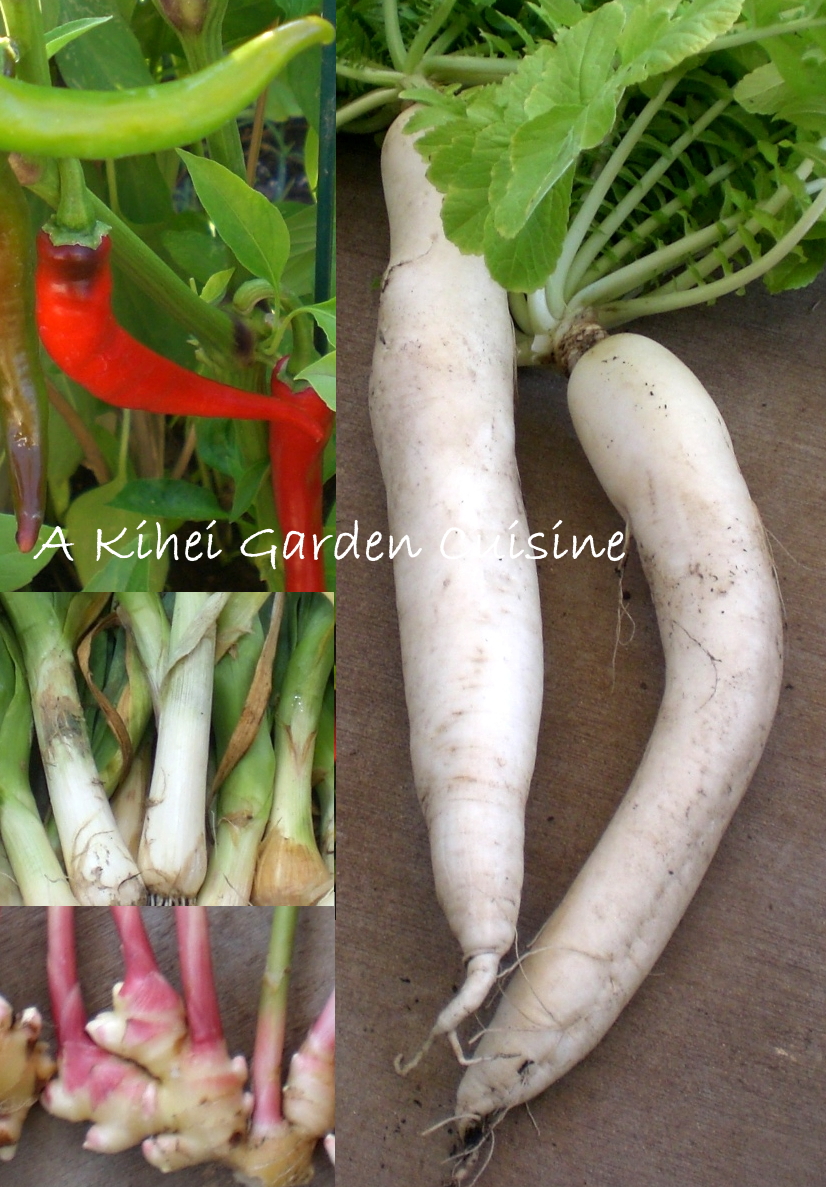
Using a spriral grater, it's in the photo above, I cut one of the daikon radishes into something that looked like angel hair pasta. I made the chili paste with dried cayanne peppers from last summer's harvest, grated a piece of fresh ginger root from my garden, added some chopped garden chives and finely diced frozen green garlic from last summer. I used chives this time as I didn't have any white bunching onions that were large enough.

The only recipe ingredients I don't grow are the apples and pears. Surprisingly, these types of fruit trees are grown on Maui but at the higher elevations.

I suggest if you don't like it too salty, rinse the grated daikon 1 or 2 additional times. Add half the chili paste and garlic and then add more to taste. It's easier to add more salt and spicy ingredients then it is to try an correct an overly salty or way too hot kim chi.

This raw, fermented kim chi is a real super-food. I like to eat it with fish and rice.


Saturday, January 1, 2011

Kim Chi for the New Year


Last week I harvested the first Testa di Ferro, an Italian savoy cabbage. The leaves are crinkled like Napa cabbage and I thought it might be perfect for making Kim Chi.


Testa grows beautifully in a wide range of climates. It's also a compact size plant that's perfect for container gardens. They're harvestable at 2.5 months and range from 2 to 3 lbs. Seeds are available from Gourmet Seed.

Dr. Ben Kim has a wonderful recipe for Kim Chi on his blog.
The recipe calls for using apple, pear and onion puree instead of sugar - it's a much healthier alternative to the commercially produced Kim Chi available from the market.

Here are suggestions I have after making Dr. Kim's recipe:

Unless you like it really salty, rinse the cabbage 1 or 2 more times
to remove more of the salt.
Add 1/2 of the crushed garlic - then add more to taste.
Add 1/2 of the hot pepper mixture - then add more to taste.

Bianca di Lucca Onions,
Cyklon Polish Paprika and New Ginger

Instead of the Ko Choo Kah Rhoo hot pepper flakes called for in the recipe, I used the Cyklon Polish Paprika that I made last summer. Cyklon is a hot paprika pepper, similar in heat level to a jalapeno. I also used some of the ginger and green bunching onions that were growing in my garden.

Dr. Kim's recipe was easy to make and the results were hot and tasty.


Wednesday, December 22, 2010

Springerle Cookies ~ Sugar Free

Springerles are an Old World cookie with more than a 400 year history. Traditionally they're made the first week of December and stored in tins for the Christmas holidays. A lovely assortment of springerle cookie designs can be seen here http://www.thespringerlebaker.com/ken_heirloom_cookies01.html

Although anise seeds and grated lemon peel are traditional ingredients, you don't have to use these flavors. If you search on-line you might be surprised as there is a good deal of interest in the art of springerle baking. There are many contemporary recipes with different flavorings that could easily be substituted for the anise and lemon.

This month I made 2 batches of springerles, one using lemons and anise seeds from my garden and the other using oranges and anise seeds.

Substituting the sugar in springerles seemed like an impossible task. Over the last few years, I've tried various alternatives without success. This holiday season I tried Just Like Sugar and it worked.

Just Like Sugar has to be added to the dry ingredients, not to the eggs as per a normal springerle recipe. On Maui, Just Like Sugar is available at Down to Earth in Kahului or it can be ordered online through the link above.

This is a good video demonstration for making a normal springerle recipe.  http://www.houseonthehill.net/video/ 
The demonstration uses Hartshorn baking powder. I haven't yet tried my alternative recipe using Hartshorn.

Just Like Sugar is a good non-toxic alternative to sugar but chemically it isn't sugar and it's not inexpensive. If it's added directly to the eggs and left to mix it results in a stiff, gummy mass. The traditional recipe I have called for 2 cups of sugar, 4 eggs, 4 cups of flour and no butter. In order to get it to work with 2 cups of Just Like Sugar, I increased the eggs to 6, reduced the flour to 3 cups and added a stick of butter. I used flour to brush the molds - it worked better for this step than the Just Like Sugar.

The Ingredients
3 c. sifted unbleached or white flour
1 tsp. baking powder
1/2 tsp. salt
6 eggs at room temperature
1 stick of unsalted butter at room temperature
2 c. Just Like Sugar for Baking
2 tsp. grated lemon or orange peel
2 Tbsp. crushed anise seeds

1) Combine the flour, Just Like Sugar, baking power and salt. Sift twice and set aside.

2) In the large bowl of an electric mixer, beat eggs at high speed until thick and lemon colored - 10 to 20 minutes.

3) At medium speed, add the butter to the beaten eggs and combine.

4) Add the lemon or orange peel and combine.

5) Remove the mixing bowl and add the flour mixture 1/2 cup at a time, combining with a spatula or wooden spoon. When the dough is too thick to mix with a spatula, knead it by hand until all of the flour is incorporated.

6) If the dough is still sticky, gradually add more flour until the dough no longer sticks to your hands.

7) Cover and refrigerate several hours or overnight.

8) Lay pieces of parchment paper over 2 to 3 cookie sheets and sprinkle with crushed anise seeds.

9) To roll out the dough, use whatever surface is comfortable. The dough is sort of like a bread dough. I used a piece of parchment paper on my counter-top and coated the parchment and rolling pin with a small amount of flour.

10) Divide the dough into 2 to 3 parts and keep each part refrigerated until ready to roll out.

The video provides very helpful information for these next steps.

11) Roll out the dough into a rectangle.

12) Brush the springerle board with flour and press firmly into dough. Lift the mold off carefully.

13) Coat the edge of a sharp knife, pastry wheel, pizza cutter or a metal scarper with flour and carefully cut along the lines in the dough.

14) Transfer the cookies to the parchment paper covered cookie sheets. Let stand at room temperature overnight or until the designs are well defined.

15) The next day, preheat the oven to 325 degrees F and bake for 10 to 15 minutes, until the cookies are a light golden color. Remove from the pan and cool completely.

16) Store cookies in a tightly covered container for 2 to 3 weeks before using.

Makes about 3 dozen cookies.

Good sources for springerle boards are Ken Hamilton's page Christmas Season Molds and Gene Wilson's page Multiple Design Springerle Boards. Both of these websites have numerous pages filled with historical information as well as other springerle boards and Old World cookie molds.

According to the book Baking With Cookie Molds, Springerle cookies were originally made only for the wealthy as they were made with expensive, imported sugar rather than local honey.

Taking springerle cookie molds to a whole new level - Cookie Molds

Friday, December 17, 2010

Greek Sweet Red Pumpkin Pie


Greek Sweet Red winter squash has that classic, sweet pumpkin flavor. They're perfect for making pie, soup and gnocchi.

For several years, I've been trying to bake a sugar free pumpkin pie. I've tried stevia, agave syrup, rice syrup and banana baby food but these products didn't work that well for this type of pie.

Recently, I tried Just Like Sugar and it was the best sugar substitute yet. I used an equal amount of Just Like Sugar to the sugar in the recipe. The pie baked perfectly and tasted pretty good.

 Just Like Sugar is made from natural non-toxic ingredients. They have granulated sugar, baking sugar and brown sugar available. It can be purchased on Maui at Down to Earth or ordered online from the Just Like Sugar website. With shipping, it's just about the same price as Down to Earth.

When I baked pumpkin pie for Thanksgiving, I tried Chez Pim's technique for making pie crust. Her recipe is the same one I've been using for many years but her technique produces a crust with a superior texture. Check out her post - One Pie Dough to Rule them All.

Friday, October 29, 2010

The Hot Pepper Super Stars of 2010

Dried Chilhaucle Negro and Santa Fe Grande

Santa Fe Grande looked similar to a jalapeno. It had about the same heat level but was very fruity and flavorful. When the peppers began growing they were pale yellow and gradually changed color to yellow-orange, orange and then red - making them ideal for color themed salsas. Santa Fe Grande is available from Baker Creek Heirloom Seeds and Seed Savers.

This was the first summer I grew mole peppers. Chilhaucle Negro was prolific and produced an abundance of dark green fruit that turned a beautiful blue-black when dried. They weren't exciting as a fresh pepper but they made a very tasty mole. Chilhaucle Negro is available from PepperMania.

Cyklon Polish Paprika

Cyklon was the super star of my paprika trials. They're similar to a jalapeno in heat level and deliciously fruity. They were great fresh and made a hot and sweet paprika powder. Cyklon is available from Seed Savers.

Trinidad Perfume

This year I experimented with several non-capsicum annuum peppers as the annuums are such a mite magnet. Trinidad Perfume, a capsicum chinense, was so ono!  It had a very low heat level and a great flavor that's difficult to describe. Mahalo Julie for the Trinidad seeds! Seeds are available from Tomato Growers and PepperMania.

Red Harbanero

Another prolific, but very hot, capsicum chinense pepper was the Red Harbanero. The plants are so beautiful and ornamental when full of ripe red peppers but the peppers are way up there on the heat scale.

Of all the many hot peppers I've grown, Red Harbanero has been the least affected by seasonal changes in daylight. The plants have been consistently productive and the fruit remain consistent in size throughout the year. The plant in the photo has been growing for 2 years.

I make a very hot and sweet pepper sauce with the Red Harbanero peppers and fresh local pineapple or papaya. Red Harbanero seeds are widely available.

I have more hot pepper seeds to trial in 2011 - maybe I'll grow the Trinidad Scorpion - one of the hottest peppers in the world.

Sunday, October 3, 2010

Amazing Summer Grown Celery

Gigante Dorato & Giant Red Reselection

For a full year I've been trialing celery seeds, trying to figure out what time of year is most ideal to grow celery in Kihei.

In the late spring I planted Gigante Dorato and Giant Red Reselection seeds. They've been growing through the summer months, the most challenging time of year. They grew beautifully in the heat of summer, defying all logic as celery is normally a cool season vegetable.

Gigante Dorato is an Italian golden celery available from Seeds From Italy. Giant Red Reselection is available from Wild Garden Seed. The Giant Red stalks were tinged with burgundy red and probably develop much deeper reds in cooler climates. I'll definitely keep Giant Red and Gigante Dorato growing in my garden year round.

Red celeries are more commonly grown in Europe. They have stronger flavors and can be somewhat bitter when eaten raw. The red celery hearts are used in salads but the celery stalks are predominately used for cooking.

 I usually let celery grow as a cut and come again plant - it's so convenient to use it fresh from the garden. 

Saturday, September 25, 2010

Winter Squash Favorites of 2010

A Sweet Kikuza - Ready to Harvest

Many factors affect the flavor and sweetness of winter squash, including the soil, amendments and the environmental conditions where they're grown.

Each summer I grow a wide variety of squash as I'm trying to find seeds that will produce sweet and flavorful results in my climate. Unfortunately, many of the squash and pumpkins I've grown in Kihei have been bland, even when cured for months. This year, these were my favorites:

Sweet Kikuza

Sweet Kikuza averaged 3 lbs and they were the sweetest of all of the squash I've grown. The vines trailed 15 to 20 feet and the plants produced at least 3 mature fruits. Kikuza doesn't need to cure for long - when they lose their green tinge and turn a bit darker they're ready to use.

Kikuza is a good squash to use for making gnocchi, soup or pie filling. It takes more than one to make soup or a pie, but one Kikuza is enough to make gnocchi.

Gnocchi has become one of my favorite things to make with squash - it can be made with any type of flavorful squash or pumpkin. Following are links for uniquely different squash gnocchi recipes. (Pumpkin Gnocchi is made with amaretti cookies.)

Marina di Chioggia Gnocchi
Black Futsu

Black Futsu averaged 1.5 to 2 lbs and they were subtly sweet. The vines trailed about 15 feet and the plants produced a least 3 mature squash. These squash also don't need to cure for long, when they turn a rich tan color they're ready to use.


I prepare the Black Futsu by slicing the squash lengthwise and baking them with butter, course salt and cracked pepper. They would be good with butter and brown sugar too.

Greek Sweet Red

Greek Sweet Red was the last squash I planted for my 2010 trials and it was the most prolific of all the varieties of winter squash I've grown. The vines trailed nearly 40 feet and produced 2 to 6 squash per vine ranging from 4 to 8 lbs. The Greek Sweet was as sweet as the Kikuza but had a distinctive pumpkin flavor - they'll be great for making pumpkin pie during the holidays.

Black Futsu, Greek Sweet Red and Sweet Kikuza seeds are available at Baker Creek Heirloom Seeds.

A Kihei Garden Cuisine


In an attempt to be contemporary, I decided to have my companion blog on Tumblr. Tumblr is like the DisneyWorld of blog hosting sites. I've complained a lot about Blogger...but...Tumblr was way over my head, It made Blogger look like a no brainer. So, Blogger it is...!